
Short answer
What to do first
Stop aggressive wheel spinning, assess the ground and vehicle position from a safe place, and call for professional recovery when the vehicle is deeply stuck, off the roadway, leaning, near traffic, or close to a drop-off, water, utility equipment, or other hazard.
Safety first
Before checking the vehicle
- Call 911 for injuries, immediate traffic danger, fire, flooding, downed power lines, or a vehicle at risk of rolling or sliding.
- Do not stand downhill, underneath, directly in front of, or directly behind an unstable vehicle.
- Stay far away from ropes, chains, straps, cables, and winch lines under tension.
- Do not attach recovery equipment to bumpers, suspension parts, tow balls, or random components.
Immediate danger, serious injury, smoke, flames, fuel odor, or an active traffic lane? Call 911 and follow emergency instructions.
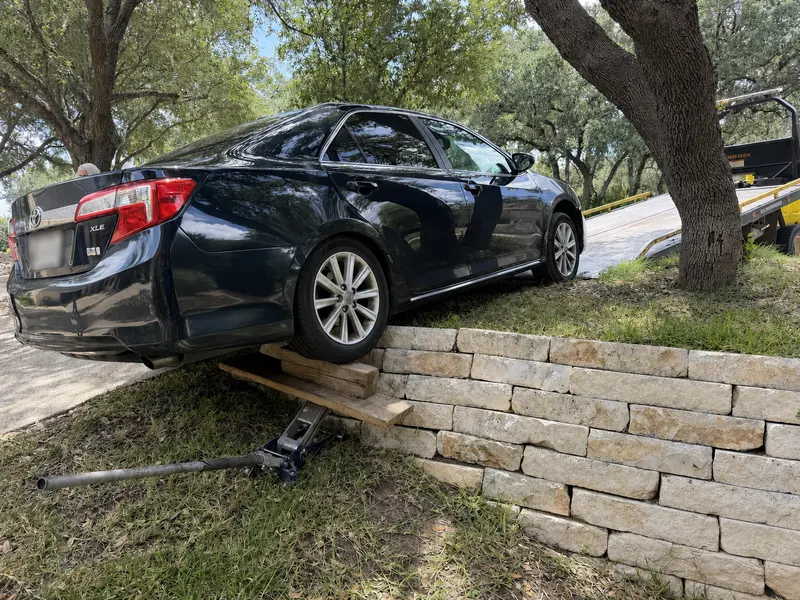
Stop before the vehicle becomes more stuck
- Take your foot off the accelerator when the tires spin without movement.
- Set the parking brake and choose the appropriate transmission position.
- Check whether the vehicle is leaning, grounded underneath, or close to a hazard.
- Keep passengers in a safe location away from the recovery path.
Basic checks only when the situation is stable
- Straighten the steering wheel if the tires are turned sharply.
- Look for shallow loose material directly around the drive tires without crawling under the vehicle.
- Follow the owner’s manual for traction-control or drive-mode guidance.
- Use only gentle input for a brief attempt on stable ground; stop if tires spin, the vehicle sinks, or it moves toward a hazard.
Why improvised pulls are dangerous
Recovery forces can be much greater than the vehicle’s weight. An incorrect attachment point or damaged strap can fail violently. Bystanders should never stand inside the path of a tensioned line or between the vehicles.
When professional recovery is the right call
- Vehicle is in a ditch, on a slope, or partly off a ledge
- Tires are buried or the underside is grounded
- The vehicle is near traffic, water, fencing, utilities, structures, or soft shoulders
- There may be suspension, steering, tire, or body damage
- A controlled pull direction and proper recovery equipment are required
When not to continue
Stop and get help when the situation is unsafe
- Do not keep spinning the tires or rapidly shifting between Drive and Reverse.
- Do not use a tow ball, random chain, or an unverified attachment point.
- Do not attempt recovery near downed power lines, moving water, unstable slopes, or active traffic.
Roadside assistance or towing?
Roadside assistance may help
A minor traction issue on stable ground may sometimes be resolved without towing, but only if the vehicle is not unstable or exposed to hazards.
Towing may be appropriate
Professional winch-out or recovery is appropriate when controlled equipment, safe attachment, traffic awareness, or vehicle transport is needed.
What to tell Zayn Towing
Share the details you can observe safely. Do not step into traffic or approach a hazard to collect more information.
- Exact location or dropped map pin
- Surface: mud, grass, sand, ditch, slope, or shoulder
- Vehicle year, make, model, and drive type if known
- Which wheels are stuck and how deep
- Whether the vehicle is leaning or damaged
- Nearby traffic, water, utilities, gates, or access limits
Frequently asked questions
Common questions about this situation
Should I keep spinning the tires to get traction?
No. Excessive spinning can dig the vehicle deeper, damage tires or driveline parts, and make the recovery harder.
Can I use a rope or chain attached to the bumper?
No. Random ropes, chains, bumpers, tow balls, and unverified points can fail dangerously. Use professional recovery equipment and approved attachment points.
What if the car is near a downed power line?
Treat the line and surrounding ground as energized. Stay in the vehicle unless fire or another immediate danger requires exit, call 911, and follow emergency instructions.
What photos help dispatch?
From a safe position, show the full vehicle position, the stuck wheels, the surface, approach access, and nearby hazards. Never step into traffic or onto unstable ground for a photo.
Safety references
This guide provides general roadside information. Your vehicle owner’s manual and emergency responders’ instructions control for your specific situation.